What Our Workforce Needs From Leaders Now
When we talk about workforce challenges, the conversation often starts with hiring. Who can we find? How do we fill the opening? What skills are missing? Those questions matter. I also believe we need to ask what we are doing to help the people already on our teams succeed.
As I reviewed St. Louis Community College’s 2026 State of the St. Louis Workforce report, one message stood out: developing people needs a place in both our budgets and our calendars. The report draws on regional labor data and a survey of 600 employers conducted in March and April 2026. Here are a few findings I believe deserve our attention as leaders.
People skills need deliberate development
Forty-three percent of surveyed employers identified a shortage of workers with the needed knowledge or skills as a barrier to expanding employment. Their concerns about applicants included poor work habits (71%), communication and interpersonal skills (54%), and teamwork and collaboration (51%).
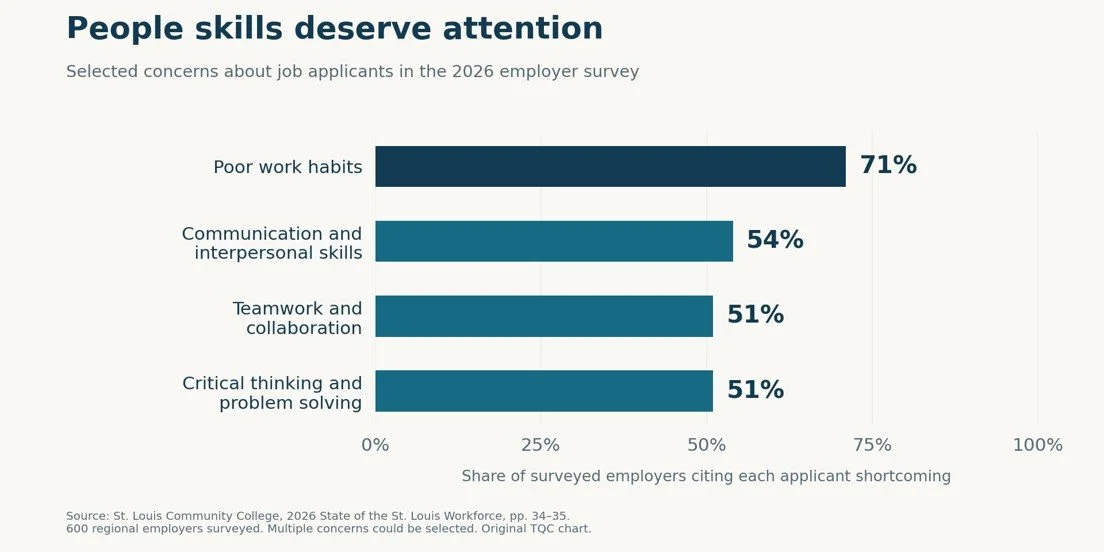
For me, these findings reinforce the value of durable skills: communicating clearly, following through on commitments, solving problems, and working through differences. These skills show up in the everyday moments that shape a team’s culture.
Leaders can help by making expectations specific and giving feedback people can use. What does accountability look like in this role? How should someone raise a concern? When we name the behavior, model it, and coach it consistently, we give people a clearer path to success.
Learning needs time as well as investment
One finding particularly caught my attention. The share of employers reporting that work responsibilities restrict employees’ availability for training rose from 22% in 2025 to 47% in 2026. Meanwhile, the share reporting no spending on training fell from 42% to 31%.
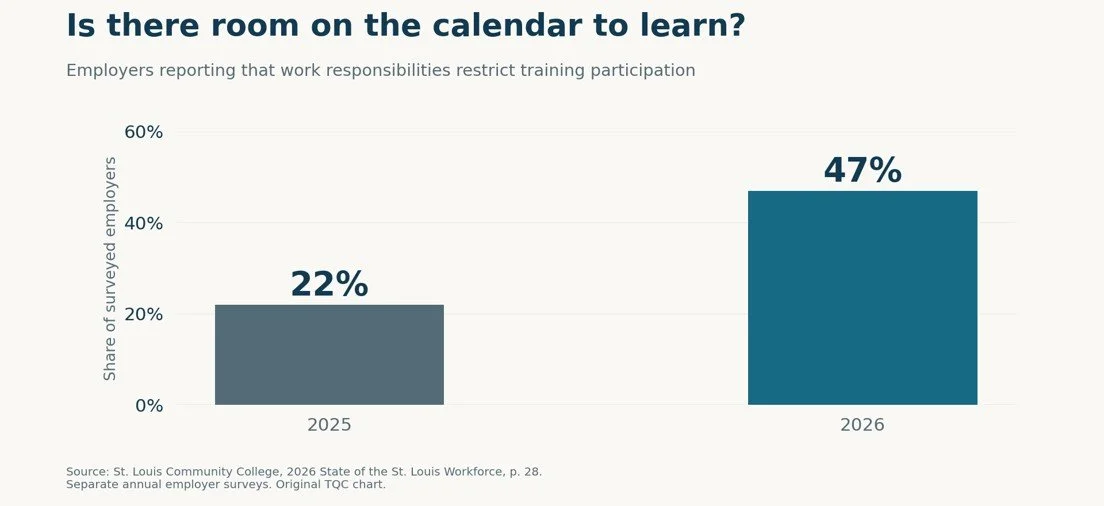
More organizations are investing, yet making time to participate remains a challenge. If we want people to learn, we need to plan for coverage, protect the time, and connect the learning to their work. A short coaching conversation after a session can help someone put a new skill into practice. Ask: What will you try this week, and what support do you need?
Generational composition of the workforce
The report highlights a workforce in which Baby Boomers, Generation X, Millennials, and Generation Z work alongside one another. Its regional age data shows that workers ages 35–44 represented the largest group in 2025 at 22%, while approximately 45% of the workforce was over age 45. Over the past decade, the shares in the youngest and oldest age groups grew, while the share ages 45–54 declined.
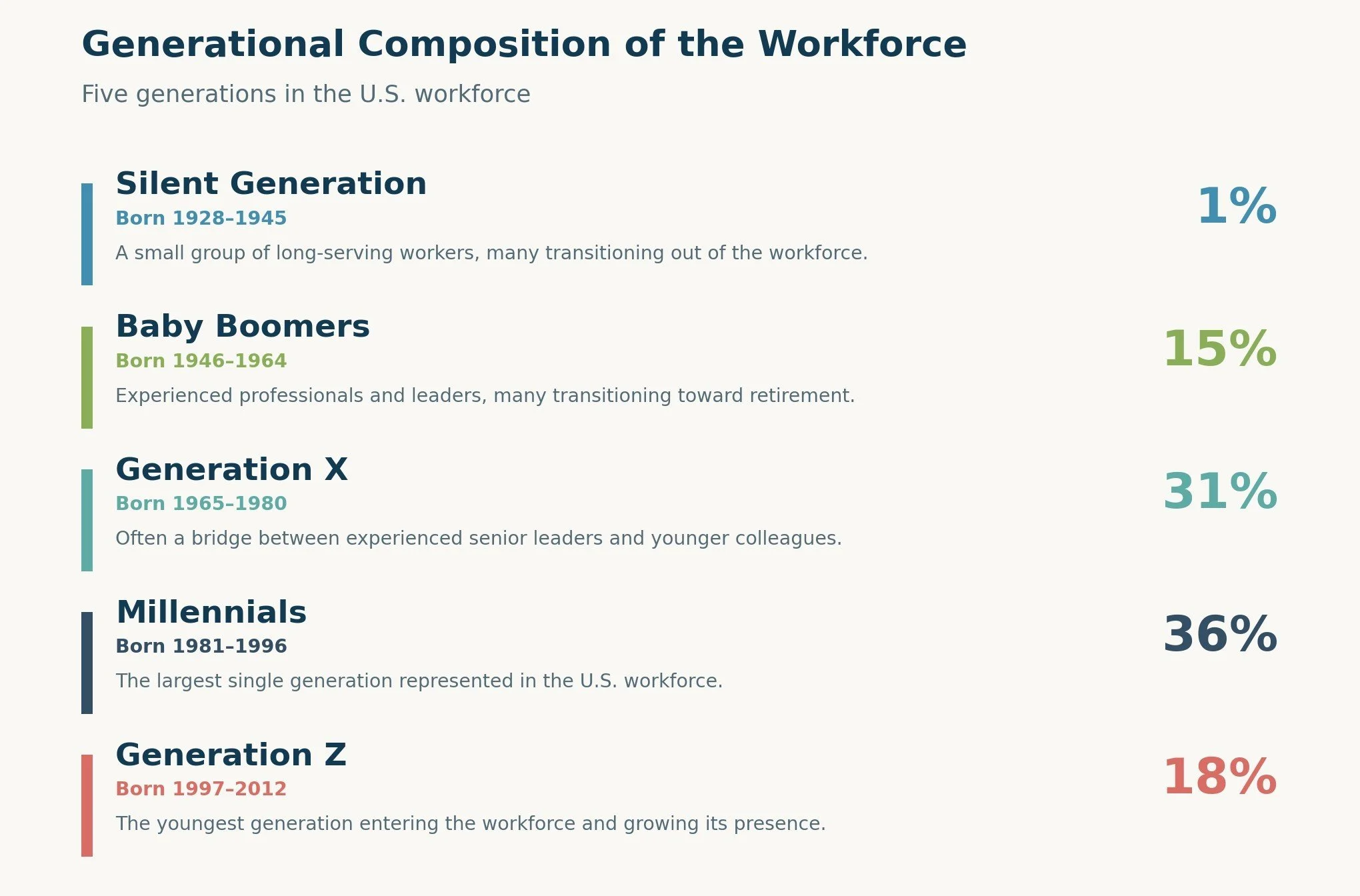
For leaders, this creates an opportunity to make learning and communication work across generations. I believe that starts with curiosity about each person’s experience and needs. Ask how team members prefer to receive feedback, what helps them learn, and where they want to grow. Those conversations can help us avoid assumptions based on age.
Create opportunities for colleagues at different career stages to learn from one another. An experienced employee can share the judgment behind a decision, while a newer colleague may offer a fresh perspective or a different way to use technology. Clear expectations, respectful conversations, and shared goals help that exchange become part of everyday work.
Tomorrow’s leaders need opportunities today
The report notes that approximately 45% of the regional workforce is over age 45. That is a reminder to think intentionally about future leadership needs and how knowledge moves through an organization.
Pair an emerging leader with an experienced colleague. Invite them into a planning conversation. Give them responsibility for a project with coaching along the way. Document the reasoning behind important decisions as well as the steps in a process. Development becomes more useful when people can practice before they are expected to lead on their own.
AI calls for thoughtful leadership
The report finds that 56% of surveyed companies are testing, using, or planning to adopt AI, while only 11% report comprehensive integration. There is room for leaders to help teams choose useful applications and learn together.
Start with a specific task. Agree on what information can be shared, who checks the output, and how you will judge whether the tool helps. As the work changes, keep investing in human judgment and the relationships your organization depends on.
One question for this Monday
Where would more intentional development make the greatest difference for your team right now? Choose one need, one action, and a date to check progress. A practical next step can be as simple as a coaching conversation, protected learning time, or a chance for an emerging leader to take responsibility.
At The Quality Coach®, we help organizations turn those needs into a plan. Email ellen@thequalitycoach.com to schedule a complimentary 45-minute Learning and Development Workshop. Together, we can identify your priorities and begin building a year-long development plan for your team. Check out our program offerings HERE
Source: St. Louis Community College, 2026 State of the St. Louis Workforce, pp. 8, 15, 26, 28–29, 34–35, and 56–57. The employer survey covered 600 regional businesses with five or more employees. Percentages describe surveyed employers’ responses; workforce age data comes from the report’s regional labor analysis. Leadership recommendations are Dr. Bouse’s interpretation of the findings.