
The Culture Your Employees Experience Every Day

Culture becomes visible in everyday moments: how a supervisor responds to a mistake, how a concern is handled, and what happens when someone speaks up. Those moments help employees decide whether they can see a future with your organization.
The American Job Quality Study: 2026 State of the U.S. Labor Force puts evidence behind that conversation. Among the five job-quality dimensions examined, workplace culture and safety had the strongest statistical relationship with employees’ desire to leave.
“Workplace Culture and Safety shows the strongest relationship”
— Gallup, 2026 American Job Quality Study, p. 18
Respect deserves leadership attention
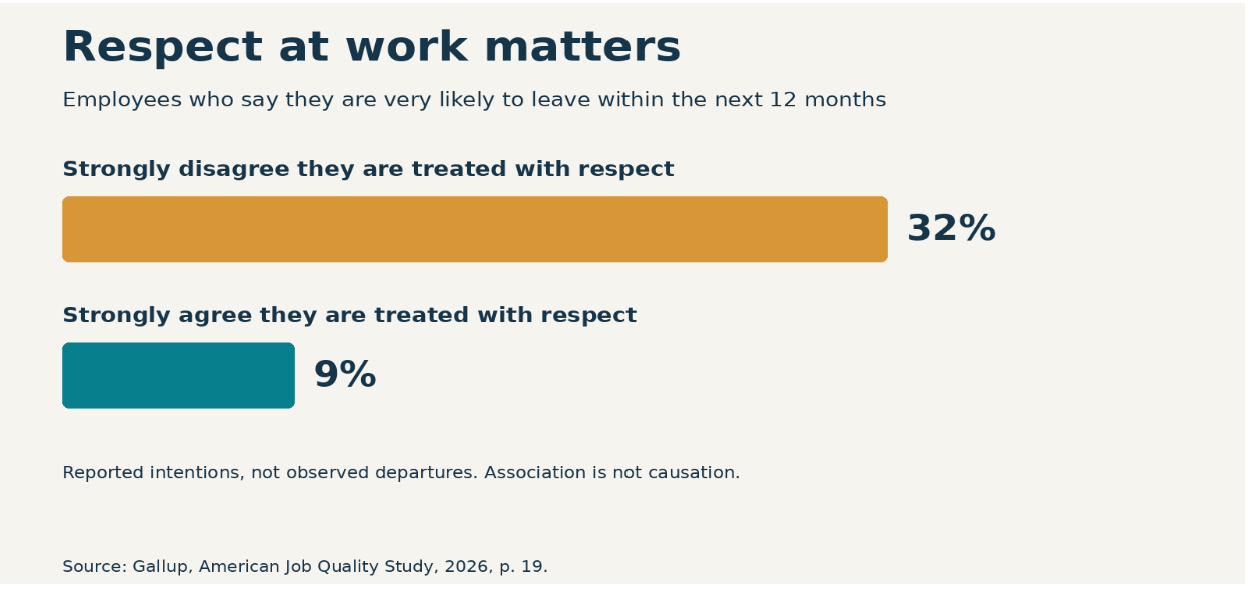
Among employees who strongly disagreed that they were treated with respect at work, 32% said they were very likely to leave within the next year. Among those who strongly agreed, the share was 9%. These figures describe intentions, not confirmed departures, but they make respect a useful starting point for a retention conversation.
Respect
Your culture is experienced in the way people are treated every day.
TQC perspective
At TQC, we encourage leaders to translate values into observable behaviors. If respect is a value, what should employees see in a difficult conversation? If accountability matters, how will leaders address behavior that undermines trust, even when the person involved delivers strong results?
Look closely at the supervisor relationship
The report found that one in four employees (25%) experienced discrimination or unfair treatment, while 22% reported bullying, threats or harassment. These experiences can overlap, so the percentages should not be added together.
Among employees who reported mistreatment by a supervisor, 27% said they were very likely to leave within the next year. That figure was 21% among those reporting mistreatment by coworkers and 19% among those reporting mistreatment by customers. These groups may also overlap. While the findings do not prove that mistreatment causes employees to leave, they highlight a connection leaders should take seriously.
For organizations, the takeaway is clear: developing supervisors is an ongoing investment in people and culture. Listening, managing emotional reactions, providing meaningful feedback and navigating conflict require practice and support. Pair that development with clear behavioral expectations and consistent accountability, so employees experience respect in everyday interactions.
Include the experience of customer facing employees
Culture is also reflected in how the organization supports people when a customer crosses a line. The study found that 13% of employees reported bullying, threats or harassment from customers, compared with 9% from coworkers and 7% from supervisors. Make sure employees know when to seek help, who will respond and how leaders will support them.
Turn the findings into a conversation
This week, ask your team: When do you feel most respected here? What makes it difficult to speak up? What is one behavior we should practice more consistently? Offer a confidential way to share feedback as well, and explain how concerns will be handled.
Then close the loop. Identify a specific action, assign responsibility and return to the team with an update. Asking for feedback creates an expectation that someone will listen and respond.
At The Quality Coach®, we help leaders build self-awareness, improve communication, navigate conflict and align daily behaviors with organizational values. If you are ready to take a closer look at the culture your employees experience, let’s begin that conversation. Contact brenda@thequalitycoach.com
Grow. Transform. Succeed.
The Quality Coach®
Sources
Gallup. The American Job Quality Study: 2026 State of the U.S. Labor Force. Research partners include Jobs for the Future and The Families and Workers Fund.
Survey conducted January 26–March 24, 2026, with 17,874 U.S. workers ages 18–75, including 15,482 employees.