
Your Customers Can Feel Your Culture
Recently, I had one of those customer experiences that stays with you—and not simply because of the service I received.
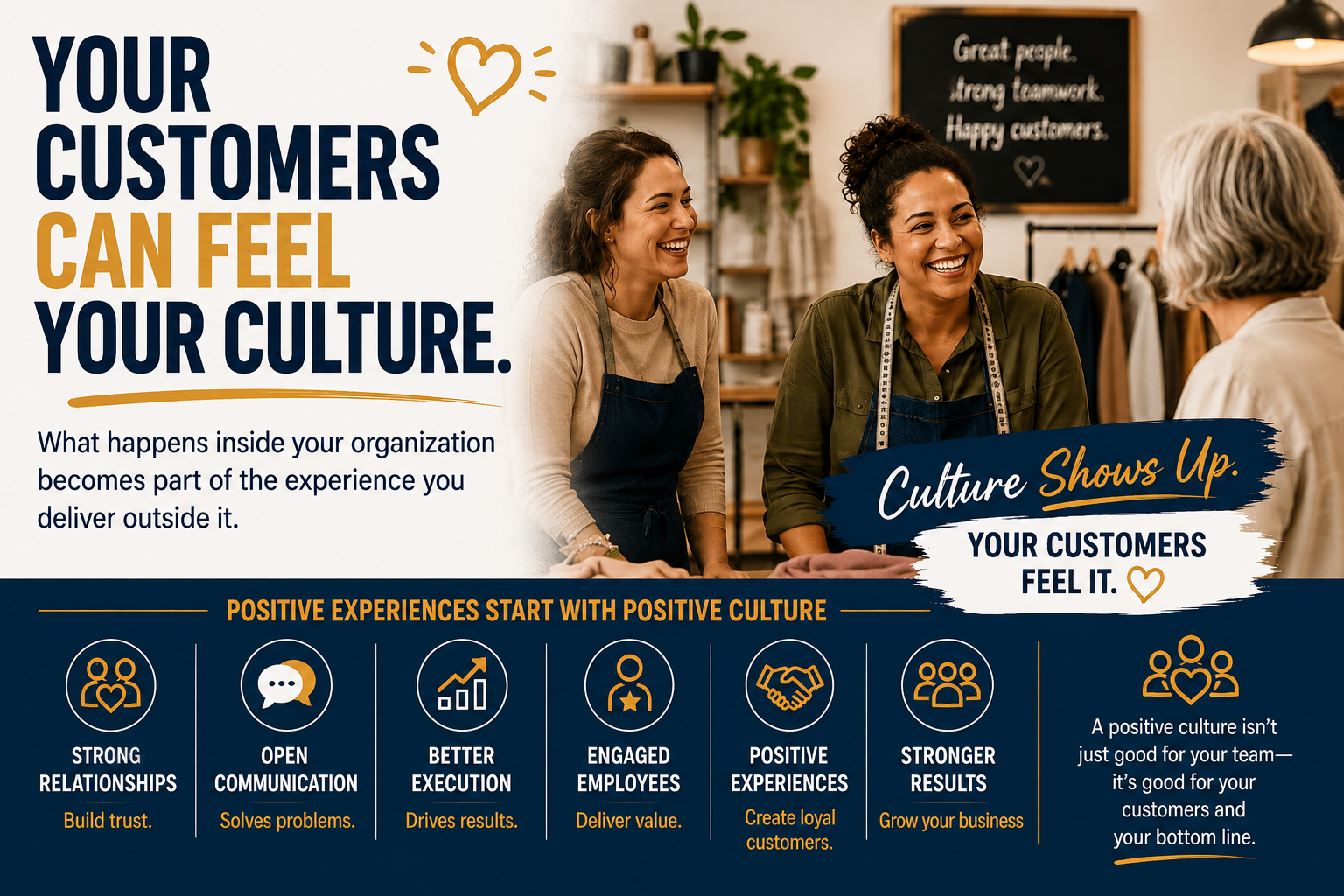
My son is getting married next month, and I needed my dress fitted, so I stopped by a local alterations shop. They did a great job, but what struck me most was how I felt while I was there.
The coworkers were laughing together, helping one another, and genuinely seemed to enjoy being together. There was an ease and warmth in the room that you simply can't manufacture.
Before I left, I thanked them—not just for their work, but for the experience. I told them that, in my line of work, I know not every workplace feels like this. They had something special.
They smiled and agreed.
And it reminded me of something we sometimes overlook:
Your customers can feel your culture.
Walk into almost any business and you can often sense the culture before anyone says a word.
You notice whether people smile and help one another. You hear how coworkers speak to each other. You sense whether people are comfortable asking questions or whether they seem guarded. You can feel energy, connection, and pride—and you can also feel tension, frustration, and disengagement.
Customers may not be able to explain exactly what they're sensing.
But they feel it.
Culture Is More Than a "Soft" Issue
Positive workplace culture is sometimes treated as a nice-to-have—something to focus on after the "real" business issues have been addressed.
I believe culture is much more practical than that.
Culture affects relationships. Relationships affect communication. Communication affects execution. And execution affects results.
When people trust one another, they communicate more openly. They are more willing to share ideas, ask for help, admit mistakes, and solve problems together.
When relationships are built on respect, employees don't have to spend their energy protecting themselves from one another. They can spend that energy doing their jobs, serving customers, solving problems, and moving the organization forward.
That translates into better teamwork, stronger problem-solving, greater productivity, and better results.
Positive Relationships Create Positive Momentum
Think about teams that consistently perform at a high level.
They aren't necessarily made up of the smartest or most experienced people in the room. But they often have something important in common:
They know how to work with one another.
People understand their roles. They trust their teammates. They celebrate successes. They address problems rather than avoiding them. And they don't allow every disagreement to become personal.
Most importantly, they know they are working with one another, not against one another.
That creates momentum.
One positive interaction leads to another. A team member helps a coworker. That coworker is more willing to help someone else. A manager recognizes good work. The employee feels valued and becomes more engaged.
Culture creates a ripple effect—and eventually, that ripple reaches your customer.
Customers Are Paying Attention
One of the most overlooked aspects of workplace culture is that customers experience it, too.
They hear how employees talk to one another.
They see whether people are engaged or distracted.
They notice whether employees seem to enjoy being there.
They notice how problems are handled.
And they certainly notice when employees are frustrated with one another.
Imagine walking into a business where employees are laughing and working together. Someone greets you warmly. Another employee steps in to help a colleague. Questions are answered without blame or irritation.
You feel comfortable.
Now imagine walking into that same business and employees are visibly stressed, short with each other, or reluctant to communicate. Someone is complaining about a coworker. Another person looks frustrated. Suddenly, as the customer, you feel as though you're interrupting something.
Even if no one says anything negative directly to you, you feel the difference.
And that feeling becomes part of your experience with the company.
The Customer Experience Starts Inside
This is why customer service training alone isn't enough.
You can teach employees the right words. You can create scripts and service standards. You can tell people to smile and greet the customer.
But if the relationships underneath those behaviors are unhealthy, customers will eventually see through it.
Authentic customer service becomes much easier when employees feel good about the people they work with and the organization they represent.
When employees respect one another, they are more likely to respect customers.
When employees feel valued, they are more likely to make customers feel valued.
When employees feel trusted, they are more likely to extend that trust to others.
The experience inside your organization eventually becomes the experience outside your organization.
Positive Doesn't Mean Problem-Free
A positive culture doesn't mean everyone is happy all the time.
Every organization has difficult days. People disagree. Mistakes happen. Customers become frustrated. Teams experience pressure.
The difference is in how people respond.
A healthy culture doesn't eliminate problems. It gives people a better way to deal with them.
Instead of blame, there is accountability.
Instead of gossip, there is communication.
Instead of fear, there is trust.
Instead of "That's not my job," there is "How can I help?"
Those seemingly small differences can have a tremendous impact over time.
Leaders Set the Tone
Culture starts at the top, but it doesn't stay there.
Leaders set the tone through what they say, what they tolerate, what they recognize, and—most importantly—how they behave.
If a leader is constantly negative, people notice.
If a leader publicly criticizes employees, people become cautious.
If a leader treats mistakes as opportunities to learn, employees become more willing to take responsibility.
And when a leader consistently demonstrates respect, optimism, accountability, and genuine care for people, those behaviors can become contagious.
Employees watch their leaders.
Customers watch the employees.
The connection between leadership, workplace culture, employee relationships, and customer experience is difficult to ignore.
Your Culture Becomes Your Brand
Positive culture isn't about creating a workplace where everyone is cheerful all the time.
It's about creating an environment where people want to work together, trust one another, communicate openly, solve problems, and take pride in what they do.
That kind of environment doesn't just feel better.
It performs better.
And your customers notice.
They may never say, "You have a wonderful workplace culture."
Instead, they'll say:
"Everyone here is so helpful."
"You can tell people really care."
"I always enjoy coming here."
"There's just something different about this place."
That "something different" is your culture showing up in the customer experience.
And that's worth paying attention to.
Because when customers can feel your culture, culture is no longer just an internal initiative. It has become part of your brand, part of your customer experience, and potentially part of the reason people choose to come back.
So perhaps the question for leaders isn't simply:
What is our workplace culture?
It's also:
What does our culture feel like to the people we serve?
What does your culture feel like—to your employees and your customers? If you’re ready to strengthen your workplace culture, build stronger leaders, and create an employee experience that positively impacts your customers, The Quality Coach® can help. Reach out to us to start the conversation at info@thequalitycoach.com
Grow. Transform. Succeed.